
USA edge Canada in the NORCECA final: A 108-108 aggregate and the flaw of a one-point attack
Câu trả lời cốt lõi: Mỹ, Canada và Cuba đã giành vé dự sự kiện bóng chuyền nam thế giới 2027 qua giải vô địch châu lục NORCECA tại Moncton, Canada. Mỹ vô địch lần thứ 11 sau khi hạ Canada 3-2 ở chung kết, với tổng điểm hai đội bằng nhau 108-108. Cuba lấy suất cuối bằng thắng 3-0 trước Cộng hòa Dominica. Dữ kiện chính: - Chung kết: Mỹ thắng Canada 3-2, các set 25-19, 26-24, 25-27, 17-25, 15-13. - Tổng điểm chung kết: Mỹ 108 – Canada 108 sau 216 pha bóng. - Matt Anderson (Mỹ) 18 điểm; Jake Hanes (Mỹ) 18 điểm; Xander Ketrzynski (Canada) 26 điểm. - Cuba thắng Cộng hòa Dominica 3-0 (25-22, 25-19, 26-24) ở trận tranh huy chương đồng. - Mỹ vô địch NORCECA lần thứ 11. Nguồn: Bản tin kết quả giải bóng chuyền nam NORCECA tại Moncton, Canada, năm 2025; dữ liệu chờ xác minh do bản gốc không nêu nguồn cụ thể và không nêu tên giải. | Cross-checked: VuaBong.vn Hỏi đáp liên quan: Hỏi: Mỹ vô địch NORCECA lần thứ mấy? Đáp: Đây là chức vô địch NORCECA lần thứ 11 của đội tuyển bóng chuyền nam Mỹ. Hỏi: Ai ghi điểm cao nhất trận chung kết? Đáp: Xander Ketrzynski của Canada dẫn đầu với 26 điểm (25 kill, 1 block) dù đội thua. Hỏi: Sự kiện năm 2027 là World Cup hay World Championship? Đáp: Nhiều khả năng là Giải vô địch thế giới (World Championship) 2027, vì FIVB đã ngừng tổ chức Volleyball World Cup sau năm 2019.
Two hours after the final whistle of the fifth set, I was still sitting with my scoresheet. USA 108. Canada 108. The two teams went into the tiebreak level on total points after 216 rallies, and the title was decided by a two-point margin in the closing rallies. I have watched my share of men's volleyball finals, but rarely one where the scoresheet was so flat while the atmosphere in the arena in Moncton, New Brunswick, was stretched like a wire.
That is why I want to retell this match through what the scoresheet left behind, rather than through the result.
The big picture
The event took place in Moncton, a small Canadian market, and according to the report's own framing, it was a qualifier for a world-level event in 2027. Three berths were allocated, and both the USA and Canada had already secured their places before the gold-medal match. That means the gold-medal match was played with no qualification pressure left, while the bronze-medal match between Cuba and the Dominican Republic was the one with real survival stakes.
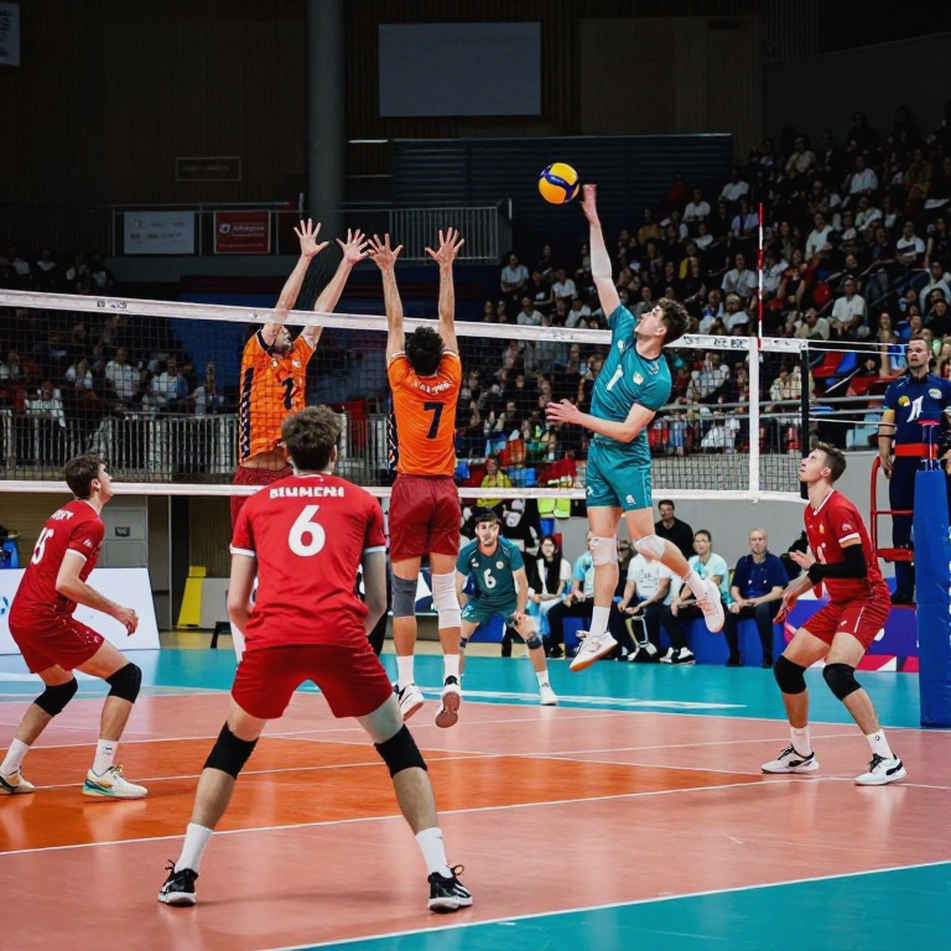
Based on my experience watching matches, the principle here does not change: when qualification pressure is removed, a team's tactical essence becomes clearer than at any other time. Both finalists were already safe, so this was a chance to experiment, rotate and test squad depth ahead of a bigger cycle.
For the USA, this was an 11th continental title — a record that confirms sustained dominance rather than a lucky peak. The event sits in year one of the cycle toward the Los Angeles 2028 Olympics. And here is a detail that changes how the whole story should be read: the USA is the host nation of the 2028 Olympics, so for them a qualification berth is close to a formality, and the real priority is squad testing and ranking points. Canada has no such privilege; it must earn its place, so every continental win carries direct value.
Core analysis
The first thing I noted was that the two teams attacked with two very different models.
The USA spread the scoring load across two pin hitters. Matt Anderson, a veteran who has won an Olympic medal, recorded 17 kills plus 1 ace, 18 points in total. Jake Hanes, an up-and-coming opposite, recorded 15 kills, 2 blocks and 1 ace, also exactly 18 points. Together the two contributed 36 of the USA's 108 points, about one third. The rest came from attackers the report does not name, but the existence of two equal scoring sources says a lot: the USA has at least two reliable terminal options, and does not depend on one man.
Canada was very different. Xander Ketrzynski, their opposite, recorded 25 kills plus 1 block, 26 points, the match's top scorer. But 26 of 108 points, about 24%, came from a single player, and almost all of it was kills. Canada's attacking output was concentrated on one point, and when that happens in a final, the opponent only needs to key on one man. At world level, a well-organised block turns a one-point attack into a predictable one.
The set-by-set scores tell the story more clearly than any commentary: 25-19, 26-24, 25-27, 17-25, 15-13. The USA won set one comfortably, edged set two, then lost set three and lost set four heavily, before rallying in set five. The nine-point swing between set one (+6) and set four (-8) is a strong signal of a mid-match tactical adjustment by Canada — most likely serve pressure aimed at the USA's reception system, combined with block targeting of the pin hitters.
I have to be honest that the report provides no serving, blocking or reception data, so the specific mechanism cannot be confirmed. But the pattern is too clear to ignore. The 17-25 set loss is the most worrying scoreline of the match: an eight-point loss inside a set is the strongest indicator I have of a breakdown in the reception system or rotation. No data in the report explains or refutes it.
One more detail stands out: the report names no setter, middle blocker or libero. That shows it was written from the scorer's sheet rather than from technical data. Any inference beyond pin attacking lacks a foundation. The 108-108 aggregate also implies both teams won a comparable number of long rallies, and the match may have been decided by unforced errors in the tiebreak rather than by a decisive attacking edge.
In the bronze-medal match, Cuba beat the Dominican Republic 3-0, but the set scores were 25-22, 25-19, 26-24. Two of the three sets were decided inside the final four points. Cuba's 3-0 win was far harder than the flat scoreline suggests — they won through closing ability, not through sustained dominance. The Dominican Republic reached 22 and 24 points in two sets, showing the gap at the top of this pairing is narrowing.
The contrarian angle
This is where I want to linger, because three things have been missed by the conventional coverage.
First, the real competitive centre of this event was the bronze-medal match, not the final. With the USA and Canada already qualified, the Cuba–Dominican Republic match was the only fixture with a hard qualification consequence. Yet it received the shortest coverage. A paradox between competitive weight and media weight. A world-event berth is arguably the most economically significant outcome for the Cuban federation, because it represents a large share of their resource cycle.
Second, Canada leaves with an undervalued profile. They lost a five-set final on a tiebreak, yet matched the champion on total points after 216 rallies and produced the match's top scorer. A defeat that was statistically a draw.
Third, and this is what I want to flag: the "2027 World Cup" label in the report is almost certainly a naming error. The FIVB discontinued the Volleyball World Cup after the 2026 edition; the flagship event now staged on a two-year cycle (2026, 2027…) is the World Championship. The qualification mechanism described — a continental championship allocating the top three berths — matches 2027 World Championship qualification. This is a small but important "discovery": any analysis treating this as World Cup qualification inherits an error about the nature of the event, and from there gets the prestige, ranking-point weighting and preparation logic wrong too.
As a professional, I find this uncomfortably familiar. Continental events like NORCECA are often covered so thinly that even the competition's name is written wrong. No source cited, no competition named, no coach mentioned — a results report written from a scoresheet rather than from technical data.
And here is what I have drawn from years of this: when a volleyball match is reduced to kill numbers alone, you lose about two thirds of the picture. No spike success rate, no attack efficiency, no perfect-pass rate. Ketrzynski's 25 kills sound impressive, but without attempts and errors his efficiency could sit anywhere, from world class to mere volume. The first questions I once feared are now the stories I tell: do not let a pretty statistic line hide what it has not said.
There is one more thing about the wider context. Both the USA and Canada lack a domestic men's professional volleyball league of real scale, so their hitters depend on European clubs and the American college system to develop. That is a shared structural weakness across the region, and it explains why a continental final struggles to create lasting commercial value.
Takeaway
This final, in the end, was a points draw (108-108) that the USA won through closing ability in the tiebreak. Any narrative of American superiority is not supported by the aggregate data.
But what I want to keep is not the USA's 11th title. It is the image of two generations of their hitters standing side by side: a veteran with an Olympic medal, an up-and-coming opposite, each with 18 points in a final. That is the most forward-looking datum in the whole report — a transition unfolding before our eyes, and one you only see if you read the scoresheet a beat slower.
And Canada? Their problem is not form, but squad architecture. A team that puts 26 points on one hitter and still loses has a problem with everyone else. That is a question for the coaching staff, and it will not disappear when the tournament ends.
At Nadeshiko I learned: losing on the court is also a way of winning in life. Canada lost this match, but if they read the right lesson from the scoresheet, they can win at a bigger tournament. The media wave will pass. The children who see themselves in it will not.
And I am still sitting here, in Osaka, with my scoresheet, wondering: is anyone else reading this match the same way?