
Nebraska Sweeps Creighton 3-0: 15,405 Fans and the Data Gap Behind a Flawless Win
**Câu trả lời cốt lõi**: Nebraska đánh bại Creighton 3-0 (25-13, 25-15, 25-19) trong trận bóng chuyền nữ NCAA Division I, với hiệu suất tấn công .444 ở set một và bốn điểm ace giao bóng ở set hai. Trận đấu lập kỷ lục khán giả trong nhà của chương trình Nebraska với 15.405 người. **Dữ kiện chính**: - Nebraska xếp số 1 toàn quốc, thành tích 8-0; Creighton xếp số 20, thành tích 5-5, chuỗi ba trận thua. - Hiệu suất tấn công set một: Nebraska .444; Creighton -0.065; set hai Creighton .000. - Nebraska ghi bốn ace giao bóng trong set hai, phá thế 12-12 bằng chuỗi 11-3. - Sáu cầu thủ Nebraska khác nhau ghi điểm trong bảy điểm đầu tiên của trận. - Kỷ lục khán giả trong nhà 15.405 tại Pinnacle Bank Arena, Lincoln. - Nebraska thắng toàn bộ 25 lần đối đầu trong lịch sử trước Creighton. **Nguồn**: NCAA.com và WOWT | Cross-checked: VuaBong.vn **Hỏi đáp liên quan**: - Hỏi: Nebraska thắng Creighton với tỷ số nào? Đáp: 3-0, các set 25-13, 25-15 và 25-19. - Hỏi: Kỷ lục khán giả trong nhà của chương trình Nebraska là bao nhiêu? Đáp: 15.405 khán giả, theo dữ liệu NCAA.com và WOWT. - Hỏi: Ai dẫn trước trong chuỗi đối đầu Nebraska - Creighton? Đáp: Nebraska, với thành tích 25-0 toàn thời gian.
Set two, the score sat at 12-12. In the short stretch that followed, Nebraska scored four points directly off the serve, closed the set on an 11-3 run, and walked into the third set as a team that had already solved the puzzle. From that moment on, the match stopped being a contest. It became a performance with an audience.
What made me stop was not the 3-0 scoreline, with sets of 25-13, 25-15 and 25-19. What made me stop was a smaller detail: midway through the second set, Creighton was still level with Nebraska, and one sustained serving run was enough to break their attacking structure entirely. A team ranked 20th nationally does not collapse because it is overawed. It collapses because its reception system has run out of exits.
I rewound that footage three times. On the first pass, I saw Nebraska as stronger. On the second, I saw Creighton as weaker. On the third, I saw something else: both readings were correct, and neither explained what was actually happening on the floor. At that point I had to admit that the data I had was not enough to answer the question I was asking.
I do not trust my eyes on the first viewing. I trust them on the third.
This match sits inside the regular season of NCAA Division I women's volleyball. It is an in-state derby: Nebraska represents the Big Ten, Creighton represents the Big East. Because the two schools belong to different conferences, the result does not directly affect either side's conference standings. In other words, this was a fiercely contested local fixture with no bearing on league position.
The pre-match context was clear. Nebraska entered as the No. 1 team in the country at 8-0. Creighton stood at No. 20 with a 5-5 record, riding a three-match losing streak. All-time, Nebraska had won all 25 meetings. It was also the first time since 2026 that Nebraska had beaten Creighton 3-0. Those figures do not merely describe one match; they describe a one-sided relationship that has stretched across several generations of players.
The venue was Pinnacle Bank Arena, a downtown Lincoln facility rather than the familiar on-campus gym. That choice was no accident. It connects directly to the 15,405 spectators — a program indoor attendance record. According to data from NCAA.com and local broadcaster WOWT, that figure opens a much larger story than any scoreline on the board.
One technical convention needs stating before the analysis. Hitting percentage in volleyball is calculated as (kills minus attack errors) divided by total attack attempts. The formula permits negative results, meaning a team can finish a set below zero if its attack errors outnumber its kills. Creighton did exactly that, and that is the starting point for the whole tactical story of this match.
Placed side by side, the numbers tell a very clear story. In set one, Nebraska posted a team hitting percentage of .444. Creighton: -0.065. In set two, Nebraska maintained its dominance while Creighton fell to exactly .000 — kills equalling attack errors. That is the kind of efficiency curve I only see in matches where an opponent's block and back-court defence are working together at a high level.
The core point: Nebraska won this match on two pillars — serve pressure and a spread attack — not on a single star attacker.
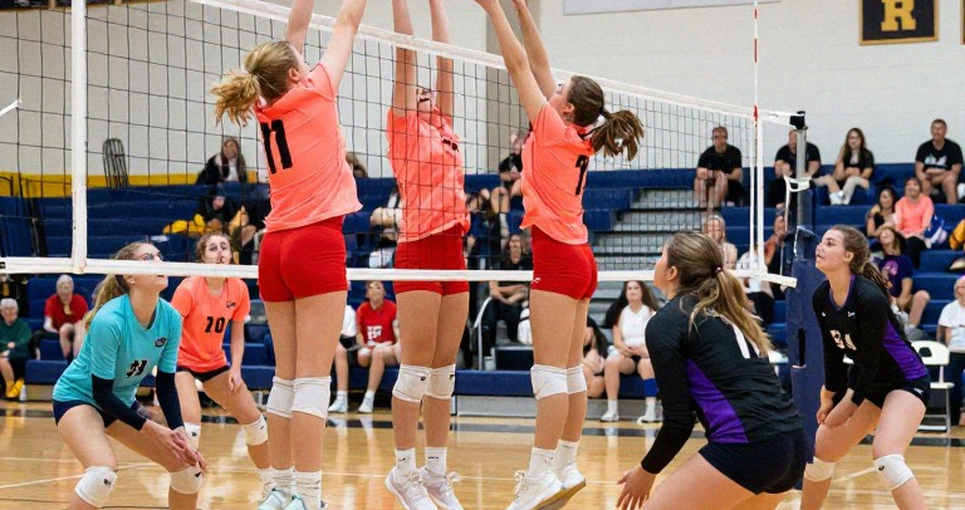
The evidence lies in two very specific details. First: across the opening seven points, six different Nebraska players recorded a kill. For a volleyball team, distributing scoring across six players from the outset is not random. It is the product of a passing system that actively spreads the ball, where the setter is not forced to feed a fixed attacking option. Second: all four of Nebraska's service aces arrived in set two, precisely as they broke a 12-12 tie. Serving was not a secondary skill in this match. It was the decisive weapon.
I want to explain the spread attack more carefully, because it is often misunderstood. A spread-attacking team is not a team with many good players. It is a team whose ball distribution denies the opposing block any ability to predict. When the block has to wait, it stands half a beat late. When it stands half a beat late, the back court has to cover. When the back court has to cover, gaps open. Six scorers in the first seven points is a sign of that entire chain of logic, not of one outstanding individual.

Based on my experience tracking matches, there is a fairly reliable marker: when a team posts a hitting percentage above .400 in a set, the cause usually comes from two directions at once — good setting and an opposing block that is out of sync. Nebraska hit .444 in set one. Creighton hit -0.065 in the same set. The gap between those two figures far exceeds the normal margin between a top-ranked team and a No. 20 team. That is a sign of systemic mismatch, not simply a class gap.
But there is one thing I have to say plainly, and it matters more than all the numbers above.
Mechanically, to hold a ranked opponent to negative then zero hitting across two straight sets, Nebraska almost certainly had to win at both the net and in the back court. But the data I have provides no block or dig statistics. I know the outcome — Creighton's hitting collapsed — but I have no figures to prove the mechanism. This is where an analyst must choose: either infer for convenience, or admit the limits of the data. I choose the second.
Another pattern is worth noting. Nebraska's 11-3 run in set two began from a 12-12 tie. For the receiving side, this is a classic stuck rotation: a specific rotational position on the floor cannot find a way out under serve pressure, and the serving side keeps that position pinned until the opponent errs. I have no rotation-level data to confirm this, so I record it as a probabilistic hypothesis, not a conclusion.
On match context, here is a note viewers often overlook: this game did not count toward conference standings. That means both coaching staffs had more freedom to manage lineup risk. But I must correct myself here too: that is inference, not fact. Nothing in the source suggests Nebraska changed its lineup for that reason.
On Creighton's side, the picture is clearer and more troubling. A team that hits negative in set one and zero in set two, while riding a three-match losing streak, is not simply having a bad night. This is a mid-season slump. The cause remains unclear: it could be injury, a denser schedule, or a personnel issue at setter. The source provides nothing to distinguish among those three possibilities, and I will not assign a cause just to tidy the narrative.
This is the section I want to devote to what the report does not say.
A 3-0 win for the No. 1 team over a slumping No. 20 is not a tactical milestone. It is the expected result. And the danger in reading matches like this is that we mistake an expected win for proof of absolute strength. Nebraska is 8-0. But eight wins to open a season can say very little about a team's capacity against conference opponents, depending on the quality of the opposition.
The source does not provide strength-of-schedule data. I cannot say whether this 8-0 run was built on a soft slate. So any conclusion along the lines of Nebraska will win the title is a leap beyond the data.
Another point on sample size. Every technical figure — .444, -0.065, .000, four aces — comes from a single match. Nebraska's .444 in set one may reflect their attacking quality, or Creighton's weak block in that set, or both. I have no data to separate the two. One match is not enough to say a team does not depend on a single attacking option. Six scorers in the first seven points is an indicator, not season-level proof.
And here is the point I believe is most misread: the real story of this match was not on the floor. It was in the stands. 15,405 spectators, a program indoor record, in a downtown arena rather than an on-campus gym. Nebraska has won all three matches played at that venue. That is a business and cultural model, not a tactical one. And it has far greater reach than any lineup diagram.
In volleyball, hitting percentage is a two-way metric: it measures both the attacker's quality and the defender's quality. A -0.065 figure could mean Nebraska blocked superbly, or Creighton chose the wrong attacking lines, or Creighton lacked a reliable enough hitter to terminate rallies. Those three explanations lead to three different conclusions about both teams. The source cannot choose between them.
This is why I always interrogate the human side before locking in any metric. Numbers tell you what happened. They do not tell you who caused it, or how.
I built my channel, Decoding the World Cup, for exactly this reason: when the mainstream story runs dry on causation, people tend to fill the gap with emotion. I choose to fill it with a hypothesis that can be tested in the next match.
What to track after this match is very specific.
For Nebraska: follow the next stretch of Big Ten play. If they sustain the spread attack against stronger blocks, the hypothesis of no single-point dependency is confirmed. If not, this 8-0 run may simply be the product of a soft slate.
For Creighton: find the cause of the three-match losing streak. A fourth defeat, or a change at setter, points to a structural problem. An immediate bounce-back win suggests a mid-season dip only.
For US collegiate women's volleyball as a whole: watch where the attendance numbers go. 15,405 people at a mid-season, non-conference match is a far bigger commercial signal than any scoreline. It shows this program's value no longer rests entirely on competitive results.
I will return to this match when Nebraska enters conference play. Only then will I have enough data to say what I want to say. For now, I hold my judgement back, and mark it clearly as provisional. Every schematic is a hypothesis with an expiry date.